22kW 3-Phase EV Charger: The Complete UK Guide
A 3-phase supply enables 22kW charging - three times faster than standard 7kW. But is it worth the upgrade? Here's everything you need to know.
Get EV Charging QuoteSingle-Phase vs 3-Phase Charging Speed
Single-Phase
7 kW
230V × 32A
~8-10 hours
for 60kWh battery (0-100%)
3-Phase (11kW)
11 kW
3 × 230V × 16A
~5-6 hours
for 60kWh battery (0-100%)
3-Phase (22kW)
22 kW
3 × 230V × 32A
~3 hours
for 60kWh battery (0-100%)
22kW charging adds about 70-80 miles of range per hour in a car that accepts 22kW: enough for a "lunchtime top-up" rather than overnight charging.
What is 3-Phase Power?
Most UK homes have single-phase electricity - one live wire delivering 230V. This powers standard 7kW EV chargers (32A × 230V = 7.36kW).
Three-phase power uses three separate live wires (L1, L2, L3), each carrying 230V but offset by 120 degrees. This creates a more stable power flow and enables much higher capacity:
√3 × 400V × 32A = 22,170W ≈ 22kW
Three times the power using cables of similar size
Three-phase is standard in commercial buildings but rare in UK homes. It's common in larger properties, farms, and newer builds designed for high electrical loads.
How to Check if You Have 3-Phase Power
Single-Phase (Most Homes)
- Service head: One fuse carrier, single thick cable
- Meter: Labeled "230V", "1-Phase", or "2W"
- Consumer unit: Narrow main switch (1-2 modules wide)
- Cables: Two wires to meter (Live + Neutral)
Three-Phase
- Service head: Three separate fuses (or one wide block with three)
- Meter: Labeled "3-Phase", "Polyphase", or "3x230/400V"
- Consumer unit: Wide main switch (3-4 modules)
- Cables: Four wires to meter (L1, L2, L3 + Neutral)
Check for "Looped Supply"
If your service head has a second cable leaving to a neighbor's property, you have a "looped supply". DNOs typically refuse high-load installations (like EV chargers) on looped supplies. You may need to "unloop" first - giving each property its own dedicated cable.
Cost to Upgrade from Single to 3-Phase
| Scenario | Typical Cost | Details |
|---|---|---|
| Basic Upgrade | £3,000 - £4,000 | 3-phase main already at property boundary, soft ground (lawn/driveway) |
| Standard Installation | £4,000 - £7,000 | Trenching across public footpath/highway, permits and road works required |
| Complex/Rural | £7,000 - £15,000+ | Long cable runs, network reinforcement needed, transformer upgrades |
Additional costs: New 3-phase consumer unit (£500-£1,500), meter tails, and potentially longer waits for a 3-phase smart meter installation.
Best 3-Phase EV Chargers (2026)
| Charger | Power | Key Features | Smart Tariff |
|---|---|---|---|
| MyEnergi Zappi | 22kW | Solar integration, "Eco+" mode, built-in PEN protection | Octopus Intelligent Go, OVO Anytime |
| Hypervolt Home 3 Pro | 22kW | Premium design, status lighting, built-in PEN protection | Octopus Intelligent Go, OVO Anytime |
| Easee One | 22kW | Compact, daisy-chain load balancing, swappable covers | Octopus via API |
| Tesla Wall Connector | 22kW | Sleek design, Tesla app integration, Wi-Fi | Tesla tariffs, basic with others |
| Andersen A2 | 22kW | Premium materials (wood/metal), concealed cable | OVO Anytime |
All models above include 3-phase support. Most are untethered (socket only) due to the heavier 22kW cable.
Cables to use with any of these chargers
The 3-phase units above are untethered — you'll need your own Type 2 cable for the car. A 3-pin granny charger is also worth keeping for unfamiliar locations. Ships from Amazon UK.
As an Amazon Associate we earn from qualifying purchases. We also work with the Awin affiliate network.
Amazon prices as of 30 Sept 2026, 11:14 UTC. Product prices and availability are accurate as of the date/time indicated and are subject to change.
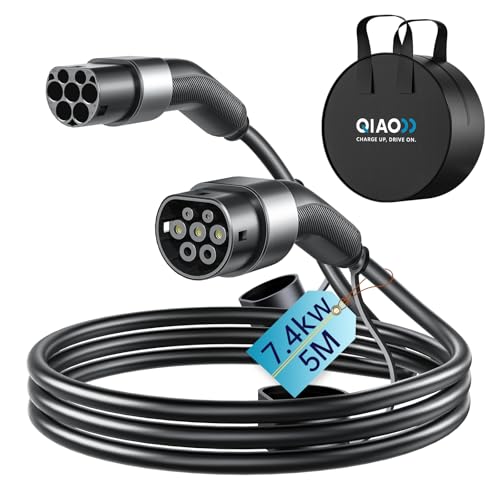
QIAO
QIAO Type 2 EV Charging Cable, 7kW - 7.4kW, 5M, 32A Single Phase
Type 2 → Type 2, up to 7.4kW / 32A, 5m. Use at any public AC charger.
![EzGoGo EV Charger Cable Type 2 to 3 Pin Plug 32.81Ft/10M Electric Car Charger 3kW, [6/8/10/13A] Type 2 Charging Cable 3 Pin EV Charger IP65 Advanced Protection Suitable for EVs & PHEVs](https://m.media-amazon.com/images/I/41XGRdcxv3L._SL500_.jpg)
EzGoGo
EzGoGo EV Charger Cable Type 2 to 3 Pin Plug 32.81Ft/10M Electric Car Charger 3kW, [6/8/10/13A] Type 2 Charging Cable 3 Pin EV Charger IP65 Advanced Protection Suitable for EVs & PHEVs
Type 2 → UK 3-pin "granny" charger, 10m. Slow but unblocks you when no installed charger is around.

dé
dé EV Charger 3 Pin Plug 10m with App, 3.12kW Electric Car Charger Type 2
Granny charger with a stated Type A RCD, 6-13A, app or button delay timer. Our top 3-pin pick.
Comparing granny chargers? See the best 3-pin EV chargers: six compared on RCD protection, current and price, with the safety checks.
The "22kW Fallacy": Check Your Car First
Critical: Most EVs cannot charge at 22kW, regardless of charger speed. The charging rate is limited by your car's Onboard Charger (OBC), not the wallbox.
Limited to 11kW (or less)
- Tesla Model 3 / Y - 11kW max in Europe
- Volkswagen ID.3 / ID.4 - 11kW
- BMW iX1 / i4 - 11kW
- Hyundai Ioniq 5/6 - 11kW
- Kia EV6 - 11kW
- Ford Mustang Mach-E - 11kW
A 22kW charger offers no speed benefit for these vehicles
Can Use Full 22kW
- Renault Zoe - 22kW standard
- Lotus Eletre - 22kW standard
- Smart #1 / #3 - Premium trims
- Audi e-tron / Q8 - Optional extra
- Mercedes EQS / EQE - Optional
- Porsche Taycan - Optional
- Volvo EX30 / EX90 - Higher trims
These vehicles benefit from 22kW charging
When 3-Phase Still Makes Sense (Even for 11kW Cars)
- • Multiple EVs: Two cars can charge at 7-11kW simultaneously without overloading
- • Future-proofing: Your next car might have 22kW capability
- • Solar integration: 3-phase enables larger solar + battery systems
Installation Requirements
BS 7671 Compliance (Section 722)
All EV charger installations must comply with the IET Wiring Regulations. Key requirement: PEN fault protection to prevent the car chassis becoming live if the combined earth/neutral wire fails. Modern chargers (Zappi, Hypervolt, Easee) have this built-in, eliminating the need for an earth rod.
DNO Notification
22kW chargers require an "Apply to Connect" application to your Distribution Network Operator. They assess whether local infrastructure can handle the increased load. This can take 2-8 weeks depending on your DNO and local grid capacity.
Grid Connection Standards
Standard EV chargers (load only) don't require G98/G99, but if you're combining with solar or V2G (vehicle-to-grid), you may need a G99 application for the generation component.
Planning a Commercial EV Charging Installation?
For businesses, 3-phase is essential for fleet charging and dynamic load balancing. Check available grants and get quotes.
Get EV Charging QuoteFrequently Asked Questions
Ready to Install 3-Phase EV Charging?
Get quotes from approved installers and check available grants for your property.
Get EV Charging Quote